

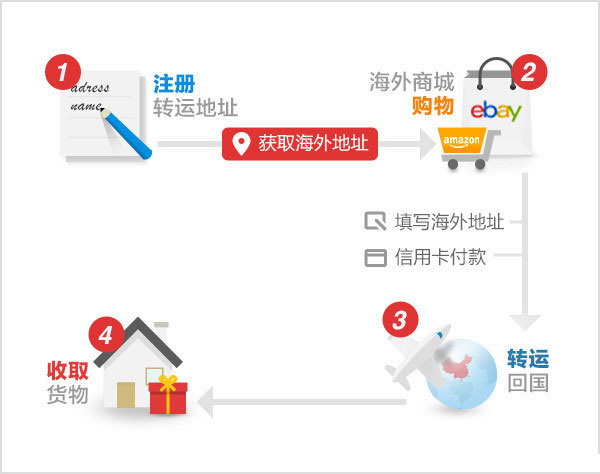
In the past two years, cross-border online shopping has been growing rapidly, and people are increasingly looking for high-quality overseas products to improve their own and their families' quality of life. Early cross-border shopping was a DIY form of self-service overseas purchasing that did not rely on proxy buyers. The main process involves registering on a freight forwarder's website, obtaining an overseas address -> shopping on foreign websites -> the freight forwarder receives the goods at the overseas address and ships them to China -> customs clearance and delivery to the consumer via courier. This method is relatively low-cost and allows you to experience the advantages of buying goods from abroad.
With developments in recent years, new forms of cross-border shopping have emerged:
The first is direct shipping from foreign merchants to China. In recent years, many foreign merchants have begun to recognize the huge potential of the Chinese market and have launched convenient overseas shopping options for Chinese users. Direct shipping works just like domestic online shopping; you only need some foreign language skills and a dual-currency card. After placing an order on a foreign website, the merchant ships the goods directly to China via courier, eliminating the need for a freight forwarder. Some merchants also offer fully Chinese-language shopping pages and support domestic UnionPay cards or Alipay, taking the overall experience to the next level.
The second is the cross-border e-commerce platforms that have been emerging in China, including traditional proxy purchasing models and bonded warehouse models. The proxy model involves helping users place orders on foreign websites, with the proxy merchant handling the entire process. The cross-border e-commerce model involves merchants stocking high-quality foreign goods in government-recognized bonded warehouses in advance. After we place an order, the merchant ships the goods from the bonded warehouse directly to us. This also offers a great shopping experience and allows us to buy quality products.
Today, we will first explain the earliest form of cross-border shopping, which is still very reliable and a genuine way to buy good foreign products. Other models naturally have their advantages, which we will discuss in detail later. Below is the process for authentic cross-border shopping.
Basic steps of the cross-border shopping process:
Quick Navigation:
- > Register with a "Freight Forwarder"
- > Start Shopping
- > Receive and Forward
- > Customs Clearance "Acquisition"
- > Summary
- > Important Notes
Except for merchants like Amazon US and SHOHPBOP, most overseas B2C merchants do not support direct shipping to China. Even if they do, the shipping costs can be high. Freight forwarders solve this problem by providing consumers with a dedicated overseas receiving address. They receive the goods overseas and forward them to China for a service fee.
The US online retail market is thriving, and the exchange rate of RMB to USD is increasingly favorable. Currently, most overseas purchases are from US merchants, and most freight forwarders offer US forwarding services. A summary of well-known freight forwarders will be provided later. Fees vary among forwarders, and customs clearance speeds differ slightly, but their functions are largely similar. After registering an account with a freight forwarder, consumers can find their US receiving address on the homepage. For specific selection methods, you can consult customer service, as the operations are generally similar across companies.
Start Shopping
Before you start, it's best to have a dual-currency credit card (Master, Visa, American Express, JCB, etc.). Many overseas merchants accept domestic credit cards, such as the famous Amazon.com. However, some merchants do not accept domestic credit cards, and we have to skip those.
The shopping process is similar to domestic B2C sites, with slight differences in the payment step. The basic process is: Register - Log in - Add items to cart - Proceed to checkout - Fill in the shipping address (the dedicated overseas address provided by the freight forwarder) - Fill in payment method - Confirm order - Receive order confirmation email.
Payment is usually by credit card. You just need to enter your card number, name, expiration date, and the CVV security code on the back of the card.
Friendly tip: Some websites may pre-authorize $1 to test the validity of your credit card. Don't worry; this $1 will not appear on your bill. Amazon.com is the largest B2C marketplace in the US, offering a wide variety of products, often at competitive prices, and imposes no restrictions on Chinese users. It is the top choice for cross-border shopping.
Since cross-border shopping requires some language skills, and Amazon US is very similar in layout and operation to Amazon China, we recommend starting your cross-border shopping journey with Amazon. You can also seek help from friends with good English skills or use translation tools as a temporary solution.
Receive and Forward
A few days after paying for the order, you can check the freight forwarder's website to see if the overseas address/warehouse has received the goods. If you are unsure or if the goods haven't been logged in for a while, you can check the tracking number in the order details on the merchant's website. Then, go to the corresponding courier website (e.g., UPS) to check the delivery status. If necessary, note down the tracking number and verify it with the freight forwarder.
Friendly tip: Some freight forwarders require manual logging. This means you need to manually enter your tracking number in the personal center on the freight forwarder's website. The subsequent steps vary slightly between forwarders, but generally involve: depositing sufficient forwarding fees into your account, registering and filling in your domestic shipping address, confirming the inbound shipment, verifying the weight (shipping fees are usually based on weight), submitting the forwarding request, and having the fee calculated and deducted. Once all steps are completed, you just wait for the goods to arrive in China.
Usually, the freight forwarder's backend has a tracking page where you can check the real-time status of your shipment and estimate the delivery time.
Friendly tip: Some freight forwarders require you to pre-load funds before using their services. It's advisable to deposit a little extra to avoid delays due to insufficient funds. Each forwarder has detailed process guides, and there are related forums for discussion. You'll understand it clearly after doing it once.
Customs Clearance "Acquisition"
Products purchased through cross-border shopping must go through customs clearance before they can enter domestic delivery. According to the General Administration of Customs of the People's Republic of China's "Notice on Adjusting Management Measures for Inbound and Outbound Personal Postal Items," effective September 1, 2010, the previous duty-free allowance for personal postal items was abolished, and all postal items with import duties exceeding 50 RMB are subject to full taxation based on the value of the goods.
If your package is selected for inspection and you need to pay customs duties, it may delay the delivery time. However, consumers shouldn't be too upset; paying taxes according to the law is the duty of every citizen. Even with customs duties, products bought through cross-border shopping are often much cheaper than buying them domestically. If duties are incurred, the freight forwarder's customer service will notify you by phone or email. After you deposit the funds, the forwarder will pay the duties on your behalf. The possibility of goods being forcibly confiscated by customs is very low.
Freight forwarders in China usually use EMS for domestic delivery, though some use couriers like ZTO or YTO. You can usually find the domestic tracking number in the freight forwarder's backend system. You can then use this number on the courier's website to check the real-time status of your package. Once the domestic tracking number shows a status, the goods will typically be "in hand" within 2-3 days.
Summary
While cross-border shopping is very tempting, it is best suited for products not sold in mainland China or for items with a significant price difference compared to the same model sold domestically. However, for very heavy items, the forwarding costs might offset the price difference, making it not worthwhile.
Additionally, you should avoid buying products prohibited by customs, such as perfumes, aerosol cans, etc. Finally, a reminder: cross-border shopping requires patience. The typical cycle takes about 2 weeks or 20 working days, which is perfectly normal. If you have any issues, you can communicate with the freight forwarder or the merchant at any time. Furthermore, if a product purchased this way malfunctions, the difficulty of returning it for repair is a challenge you may face.
Important Notes:
a. Some websites have their own Gift card systems that can be used like cash. The most common one people encounter is Amazon's Gift card. Due to the prevalence of "black cards" (obtained from stolen credit cards) in the online market, we do not recommend buying gift cards on Taobao. Moreover, with the RMB becoming increasingly favorable against the USD, the hassle and risk of buying gift cards no longer outweigh the small savings.
b. Each website has its own policy for free domestic US shipping. For example, Amazon US offers free shipping on orders over $35, and brand official websites like Timberland occasionally have free shipping promotions. Amazon US's Free Shipping service typically takes 5-7 business days to reach the US receiving address. If you are in a hurry, new users can try Amazon Prime. This service offers a free one-month trial for each user. Typically, this service is an annual subscription costing $99 per year, providing free 2-day delivery on all orders, regardless of the amount spent.
c. Since product packaging can be heavy, you can save on shipping costs by using consolidation services when ordering multiple items. For example, if you have a 1.1 lb e-reader and a 0.3 lb pair of headphones, shipping them separately would cost for 2 lbs + 1 lb = 3 lbs. If you request consolidation, the freight forwarder's staff will open the packages, combine the items, repack them, and weigh them together, potentially costing only 2 lbs in shipping. However, consolidation can delay delivery, especially during peak times like Black Friday when forwarders are overwhelmed. It's best to avoid requesting consolidation during such periods. Some forwarders also offer additional services like reinforcement or adding newspaper padding, which may incur extra fees.