

First, let's review the recent Amazon policy adjustments:
Ban on non-essential product inbounding
From March 17 to April 5, Amazon announced it would prioritize the delivery of medical supplies and household essentials, stop inbounding non-essential FBA products, and prohibit the creation of shipments for non-essential items. This policy applies to the U.S. and European markets.
Priority inbounding for some products
After April 5, only certain products were accepted for priority inbounding, leaving many sellers' restocking plans on hold.
Extended return window
Extended the return window for U.S. customers to after May 31.
Suspension of Amazon Shipping service
Amazon will suspend its Amazon Shipping service in June.
Postponement of Prime Day
Prime Day is usually held in July each year, but this year it will be postponed until at least August.
Restrictions on shipment quantities
On April 18, all products on Amazon U.S. became eligible for restocking, but shipment quantities were restricted.
In fact, these policies indicate that Amazon is not slowly returning to normal, but has become stricter than before!
Many products that previously had no quantity limits are now heavily restricted. What's the use of being able to send 1,000 units before but now not even 100?
Multiple sellers expressed:
The shipment restriction operations are too surreal, showing that the platform is getting increasingly strict. Under the pandemic, Amazon has gradually figured out ways to cope, ultimately forming a long-term new normal for shipping, and the situation ahead may become even tougher.
On one hand, sellers face limited restocking; on the other hand, Amazon is also trying to restrict consumer purchases:
Amazon has removed deal pages and product recommendations from its homepage, canceled common group-buy lists for each product, and stopped accepting new discount coupons from brands. These changes will reduce the frequency of consumer shopping on Amazon.
Overall, for merchants looking to launch new products or boost sales of existing ones, there are fewer and fewer places to reach new customers on Amazon. Thus, launching new products becomes more difficult, and the platform becomes even harder to navigate.
It is precisely in this "sluggish" atmosphere that independent websites have emerged, especially for pandemic-related products. Due to strict controls on listing pandemic supplies by third-party platforms, many sellers are turning to independent websites to sell such items.
According to sellers, sales exceeding ten million are not uncommon. Additionally, a survey released by Yuguowang shows that 25% of sellers are already selling pandemic supplies on independent websites.
In fact, over the past two years, independent websites have been popular among sellers. Under the global pandemic's influence, the fuse for independent websites has finally been lit. Many platform sellers are transitioning to test independent websites, not only because of the business opportunities revealed during the pandemic but also due to the inherent characteristics of independent websites.
(1) Independent websites are not restricted by platform policies:
For example, Amazon blocks the listing of new products related to COVID-19 and no longer accepts sales applications for such products. However, on independent websites, there are no such restrictions, and sellers can freely sell goods. Recently, stories of counter-trend growth have mostly focused on independent websites.
(2) Independent websites allow customer accumulation:
On platforms, no matter how good the sales are, customers ultimately belong to the platform, and sellers cannot access any user data. With independent websites, sellers can obtain first-hand customer information and use accumulated user data to create marketing plans targeting different groups.
Example: Beer and Diapers
When Walmart analyzed consumer shopping behavior, they found that male customers buying baby diapers often also grabbed a few beers to reward themselves. So, they tried a promotion placing beer and diapers together, which unexpectedly led to a significant increase in sales of both diapers and beer.
This is precisely because the platform itself has access to first-hand user data, enabling targeted marketing strategies. Sellers on the platform cannot see relevant data, so the best way for sellers to develop data-driven marketing plans is through independent websites.
In the past, when independent websites were easy to manage, everyone flocked to them; when Amazon's dividends arrived, everyone crowded onto Amazon; as competition on platforms like Amazon intensified, people started considering independent websites again. In 2018, I also wrote an article like this:
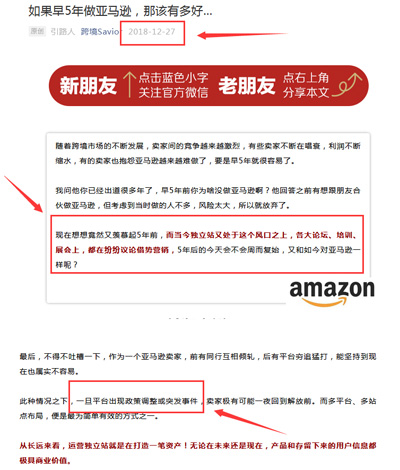
Imagine if you had started an independent website back in 2018, before competition got fierce, before the concept of independent websites spread to the average seller, and before advertising traffic costs were high—by now, you would have accumulated a large user base.
Currently, as the number of independent website sellers increases, the traffic costs from advertising channels have also risen, which can be seen as a direct result of competition. However, compared to platforms, the market boundaries for independent websites are still very broad, making it less likely for sellers to have direct confrontations.
In short, operating an independent website is not as complicated as sellers might imagine. If your main product category is struggling to break through in the short term, you can appropriately offer some pandemic-related products (masks, hand sanitizers, etc.) to maintain performance and accumulate users.
Moreover, due to the special nature and essential demand for mask products during this period, the effectiveness of every promotional channel will be 5 times, 10 times, or even higher than that of ordinary products in the past, leading to exponentially increased user accumulation.
After the pandemic passes, you can switch back to your main product category on the website and use email to conduct secondary marketing to the users accumulated during this period.
In the long run, operating an independent website is about building an asset! Whether in the future or now, the retained user information holds immense commercial value.